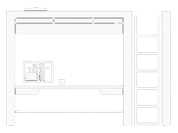
A bunk bed with a desk underneath is one of the smartest pieces of furniture you can put in a child's bedroom. You get a proper sleeping space above and a full study area below — all in the same footprint as a standard single bed. In a country where the average bedroom is getting smaller, that matters.
This guide covers everything you need to know before you buy. Sizes, materials, safety, who they suit, and which style works best for your home.
What Is a Bunk Bed with a Desk Under?
It's exactly what it sounds like. The top bunk is a standard sleeping area. The space underneath, instead of a second bed, holds a built-in desk. Some models include shelving, drawers, a wardrobe section, or a combination of all three.
These are sometimes called desk beds, loft beds, or study bunk beds. They're designed primarily for children and teenagers but suit small adult rooms too.
The key advantage? Floor space. A traditional bed plus a desk takes up two separate areas of a room. A bunk bed with a desk under combines both into one unit — often saving 2–4 square metres in a bedroom.
Who Are They For?
Honestly, they work well for a wide range of situations:
- Children aged 6 and up who need a dedicated study spot
- Teenagers who want a bedroom that feels like their own workspace
- Students in small rooms or shared houses
- Parents fitting out a box room or smaller second bedroom
- Two siblings sharing a room — one sleeps on top, one uses the desk below
If your child is doing more homework, gaming, or creative projects, a proper desk under their bed makes a huge difference. It keeps work separate from play without needing a second room.
High Sleeper vs Mid Sleeper: What's the Difference?
This is one of the first decisions you'll make. The height of the top bunk determines how much usable space sits underneath.
High Sleeper Desks
A high sleeper desk bed raises the sleeping platform to full loft height — typically 150–170cm from the floor to the mattress base. This gives you the most usable workspace underneath. An adult can comfortably sit at the desk, and there's often room to stand beneath the frame.
Best for: older children, teenagers, and adults. Not recommended for young children who might find the climb difficult or the height unsettling at night.
Mid Sleeper Desks
A mid sleeper desk bed sits at a lower height — typically 90–120cm to the mattress base. There's still a usable desk area underneath, but it tends to be a smaller, more enclosed space that younger children often love. Think of it as a den below and a bed above.
Best for: younger children aged 6–10. The lower height makes climbing easier and feels less daunting at night.
Quick rule: If your child is under 10, a mid sleeper is usually the safer and more practical choice. Over 10, a high sleeper gives far more workspace.
Key Features to Look For
1. Desk Size and Surface Area
The desk is the whole point. Check the actual dimensions before you buy.
- A desk under 80cm wide is tight for schoolwork — fine for a younger child but restrictive for a teenager
- 90–120cm is the sweet spot for most children doing homework and using a laptop
- Some models extend the desk across the full width of the bed frame
Also check the desk height. Standard adult desk height is 72–75cm. For younger children, lower is better — look for something around 65–68cm.
2. Storage
Most desk bunk beds come with at least some storage. Common options include:
- Shelving above or beside the desk — great for books, stationery, and displays
- Under-bed drawers on the lower level
- Wardrobe sections built into the frame — some models include a full-length hanging space
- Bedside shelves on the upper bunk
If the bedroom has limited wardrobe space, look for a model that combines desk and storage in one unit. Several of the wood bunk bed with desk options do this particularly well.
3. Access to the Top Bunk
How your child gets up and down matters more than people realise. There are two main options:
Ladder Access
The standard option. Vertical ladders take up less floor space. Angled ladders are easier to climb but stick out further into the room. Check that the ladder rungs are wide enough — at least 30cm — and have a non-slip surface.
Staircase Access
A desk bed with steps replaces the ladder with a proper staircase. This is significantly safer for younger children and often includes built-in storage drawers in each step. Steps take up more floor space but are much easier to use in the middle of the night.
If your child is under 8 or you're worried about safety, steps are worth the extra space they require.
4. Guard Rails
Every top bunk must have guard rails on both sides. UK safety standards (BS EN 747) require:
- Guard rails on all open sides of the upper bunk
- A minimum gap of no more than 75mm where the mattress sits
- Rails must be at least 160mm above the top of the mattress
Always check that any bed you're considering complies with BS EN 747. Reputable UK retailers will confirm this in the product specification.
5. Weight Limits
All bunk beds have a stated weight limit for the upper bunk. This is usually between 70kg and 100kg for a single upper bunk. Check it against the actual weight of whoever will be sleeping on top — plus a small safety margin for movement during sleep.
Materials: Wood vs Metal
The two most common materials for bunk beds with desks are wood and metal. Both work well — the right choice depends on your style preference and practical needs.
Wood Bunk Beds with Desks
Wood bunk desk beds have a natural, warm look that suits most bedroom styles. Solid wood is the most durable — pine and beech are common choices in the UK. MDF (Medium Density Fibreboard) is more affordable but less robust over time.
What to check when buying a wooden bunk bed:
- Is it solid wood or MDF with a wood veneer? Solid wood handles wear far better
- What finish is used? Water-based, non-toxic paints and lacquers are safest for children's rooms
- Will it take a repaint? Solid wood can be sanded and repainted. MDF is harder to refinish
Metal Bunk Beds with Desks
Metal desk beds are typically made from tubular steel with a powder-coated finish. Powder coating is a process where electrostatically charged paint particles are applied to the metal and then heated to form a hard, durable surface — much tougher than standard spray paint.
Metal beds tend to be:
- Lighter than solid wood equivalents
- Very strong for their weight
- More industrial or modern in appearance
- Often less expensive than solid wood at the same quality level
The downside? Metal can feel cold and stark. In a child's bedroom, wood often creates a warmer atmosphere. That said, a well-chosen metal frame in the right finish can look excellent.
Colour Options
The colour of a bunk bed matters because it's a large piece of furniture that will dominate the room. The three most popular options in the UK are white, black, and natural wood tones.
White Desk Beds
White desk beds are consistently the most popular choice for UK bedrooms. White reflects light, which is particularly helpful in rooms with limited natural light. It also works with almost any wall colour and bedding.
White finishes on MDF can chip over time. If you're buying white, check whether it's a painted solid wood or a foil-wrapped MDF — the latter is more prone to marking.
Black Desk Beds
Black desk beds suit teenage bedrooms particularly well. They look sharp against white or grey walls and hold their appearance even with heavy use — marks and scuffs are far less visible on a dark finish than on white.
Black metal frames in particular have a clean, utilitarian look that older children tend to prefer to the more "childish" styles.
Pink Desk Beds
Pink desk beds are a popular choice for younger girls' rooms. They range from soft blush tones to deeper rose shades. Many are available in MDF with a painted finish — check the quality of the paint before buying, as cheaper options can show wear quickly.
Gaming Desk Beds
For children and teenagers who game seriously, a standard desk might not be enough. Gaming desk beds are designed with wider surfaces, cable management channels, and sometimes built-in LED lighting strips.
Key features to look for in a gaming setup:
- Desk width of at least 100cm — to fit a monitor, keyboard, and mouse comfortably
- Cable management — holes or channels in the desk surface to route cables neatly
- Monitor shelf — raising the screen to eye level reduces neck strain
- LED lighting — mostly aesthetic, but it's a feature teenagers value
- Headset hook — small but genuinely useful
A gaming desk bed with these features can replace multiple pieces of furniture: the bed, the desk, the monitor stand, and sometimes a shelving unit too.
Room Size and Ceiling Height
Before you buy, measure your room carefully. Here's what you need to check:
Floor Space
Most single bunk beds with desks fit a 90cm x 190cm or 90cm x 200cm mattress. The overall frame will be slightly larger — check the product dimensions, not just the mattress size. Allow at least 60cm clearance around the bed for access.
Ceiling Height
This is where people often get caught out. For a high sleeper, you need:
- Mattress base height: typically 150–165cm
- Mattress depth: 15–25cm (check your mattress spec)
- Clearance above the mattress for sitting up: at least 75cm
- Guard rail height above mattress: 16cm minimum
That means you need a ceiling height of at least 240–250cm for a high sleeper, and ideally 260cm or more. Standard UK ceiling height is around 240cm in modern homes — which is workable but tight. Victorian and Edwardian properties with higher ceilings are ideal.
Mid sleepers require less clearance — typically 210–220cm ceiling height is sufficient.
Mattress Recommendations
Most bunk beds with desks are sold without a mattress. You'll need to buy one separately. Key points:
- Maximum mattress depth: most manufacturers specify a maximum — commonly 15cm or 18cm for the top bunk. Exceeding this reduces the effective height of the guard rail, which is a safety issue
- Mattress type: foam or pocket spring both work. Avoid very thick memory foam mattresses on top bunks as they compress the guard rail clearance
- Size: confirm whether the bed takes a UK single (90 x 190cm) or European single (90 x 200cm) — these are not interchangeable
Assembly
Bunk beds with desks are large, complex pieces of furniture. Assembly typically takes 2–4 hours for two adults. A few practical tips:
- Clear the room as much as possible before you start
- Don't attempt it alone — you need a second person to hold panels while you fix them
- Read the instructions fully before starting, not as you go
- Tighten all bolts fully. Then go back and check every one again after assembly — joints can work loose as the bed settles
- Check all bolts monthly, especially in the first few months of use
Some retailers offer a professional assembly service. If the thought of putting together a large flat-pack fills you with dread, it's often worth the cost.
Safety: What the Regulations Say
In the UK, bunk beds must comply with BS EN 747. This standard covers:
- Structural strength — the bed must withstand specified loads without failure
- Guard rail dimensions and height
- Ladder spacing and grip
- Opening sizes — gaps must prevent a child's head from becoming trapped
- Flammability of materials
The minimum age recommendation for the upper bunk of any bunk bed is 6 years old. Children under 6 must not sleep on a top bunk under any circumstances.
Also check that the slatted bed base (the wooden slats that support the mattress) is included and meets the standard. Some cheaper beds are sold without an adequate base.
Price Ranges: What to Expect
Bunk beds with desks cover a wide price range in the UK. Here's a rough guide:
- Under £300: Entry-level MDF or thin metal frames. Fine for occasional use but may not hold up to daily wear for years
- £300–£600: Mid-range options. Better MDF or solid pine frames, more storage, better hardware. The sweet spot for most families
- £600–£1,000: Solid wood construction, wider desks, more thoughtful designs. Worth it if you want the bed to last 8–10 years
- Over £1,000: Premium solid wood or custom-built options with large workspaces and extensive storage
Consider the cost per year of use. A £600 bed that lasts 10 years costs £60 per year. A £250 bed that falls apart after 3 years costs £83 per year — and causes far more disruption.
Questions to Ask Before You Buy
- What is the maximum mattress depth for the top bunk?
- Does this comply with BS EN 747?
- What is the weight limit for the upper bunk?
- Is a slatted bed base included?
- What are the actual room dimensions needed — not just the bed dimensions?
- Is assembly included or available?
- What is the returns policy if the bed doesn't fit?
Choosing the Right Style for Your Room
Here's a quick summary to help you narrow down the choice:
- Small bedroom, younger child: mid sleeper desk bed with steps and built-in storage
- Teenager who needs a proper study space: high sleeper desk bed with a wide desk surface
- Child who games: gaming desk bed with cable management and a wide surface
- Safety a priority, younger child: desk bed with steps
- Modern or industrial look: metal desk bed in black or grey
- Classic, warm feel: wood bunk bed with desk in natural pine or white paint
- Contemporary bedroom: white desk bed
- Teenage bedroom: black desk bed
- Younger girl's room: pink desk bed
Final Word
A bunk bed with a desk underneath is a practical, long-lasting investment for any bedroom where space is limited. Buy based on the actual ceiling height of your room, the age and weight of your child, and the desk size they genuinely need — not just what looks good in a photo.
Check the compliance certifications, measure twice, and pick a material and finish that will hold up to years of daily use. Get that right and you'll have a piece of furniture that works hard for the next decade.