Our product rankings are based on analysis of thousands of customer reviews, brand reputation, pricing trends, and popularity data. They represent our honest opinion and are intended as a helpful starting point for your research. Some links on this site are affiliate links — if you buy through them, we may earn a small commission at no extra cost to you. This helps us keep the site free and up to date.


A desk bed is a raised bed frame with a built-in work surface below or beside it. Instead of a separate bed and desk taking up two parts of the room, the sleeping area goes up and the desk slides underneath, freeing floor space for a chair, storage or simply room to move. The black versions are the same designs finished in matt or gloss paint, powder-coated steel or painted pine.
Most frames take a standard UK single mattress (90 x 190cm), though a few gaming models come as a 4ft6 double. The work surface is usually fixed, full-width and deep enough for a laptop or a monitor and keyboard, with shelves above or to the side.
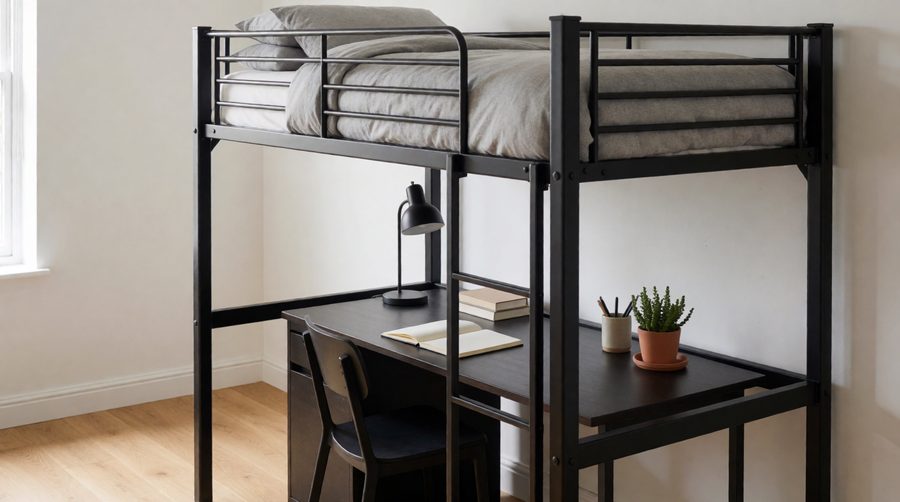
The bed sits roughly 1.4 to 1.5m off the floor, high enough to sit, and on some models stand, underneath. This is the most popular format because it gives a full-size workspace in the footprint of a single bed. Our high sleeper desk beds collection covers the full range in every finish.
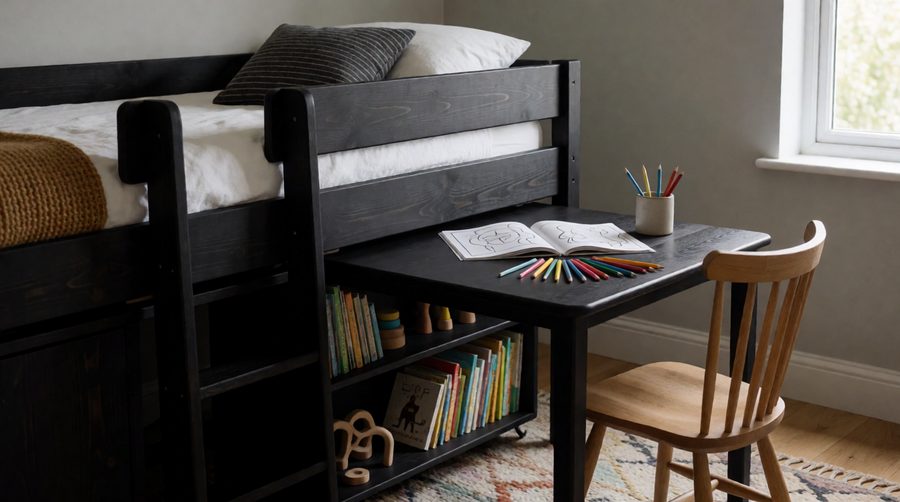
Mid sleepers are lower, typically 70cm or so to the underside of the bed, with a pull-out or side desk and storage. They are easier for younger children to climb and less imposing in a small room. See our mid sleeper desk beds for more.
For shared rooms, some frames combine a top bunk, a desk and either a second bed or a futon below. A wood bunk bed with desk gives a softer, more traditional look if dark metal feels too stark.
Gaming designs add wide or L-shaped desks for two monitors, PC trays, cable management, RGB lighting and sometimes wireless charging. Many of the frames in this range are gaming models from X Rocker, Recoil and Noa and Nani; our gaming desk beds page has the rest.
Some high sleepers swap the ladder for a staircase with drawers or cubbies built into each step. They are steadier to climb and add storage, at the cost of a longer footprint. Browse desk beds with steps.
Specifications from the manufacturers' listings for some of the frames in this collection:
| Model | Type | Frame | Desk | Max weight |
|---|---|---|---|---|
| Noa and Nani Storm | High sleeper, 180cm tall | Solid pine | Reversible desk | 70kg |
| Noa and Nani Typhoon | High sleeper, 180cm tall | Pine | Full-width, two tiers | Not stated |
| X Rocker Fortress | High sleeper, 147cm to bed base | Steel | Fits a 40-inch screen, 3 shelves | 180kg |
| Costway metal loft bed | High sleeper, 146cm clearance | Steel | 192 x 39cm at 72cm high | 220kg |
| Bonnlo loft bed | High sleeper, 182cm tall | Steel | Full-width, power outlet and LED strip | 200kg |
| XR Living Denver | High sleeper, 183cm tall | Metal with oak-effect melamine | Wireless charging pad | 100kg |
| X Rocker Sanctum | Mid sleeper, 70cm under bed | Steel | Gaming desk | 180kg |
| X Rocker Battlebunk XL | 4ft6 double high sleeper | Steel | Extra-large L-shaped, 10W wireless charging | 180kg |
Two things stand out. Weight limits vary hugely, from 70kg on some children's pine frames to 200kg or more on steel loft beds, which matters if a teenager or adult will use it. And the space under the bed ranges from about 70cm on a mid sleeper to nearly 150cm on a full high sleeper.
Steel frames, usually powder-coated, are strong for their weight, slim in profile and suit an industrial or gaming look. They are the choice for higher weight limits; browse our metal desk beds for every colour. The trade-offs are that joints can loosen and creak over time, so check the bolts every few months, and chips in the coating show silver underneath.
Painted solid pine and MDF frames feel more like conventional furniture, are quieter and often include drawers and cupboards. They are heavier to move and usually carry lower weight limits. A scratch in the paint can be touched up with a matching furniture paint pen.

Check the overall height of the frame (most high sleepers here are 180-183cm) and add the depth of the mattress. Then measure your ceiling and make sure there is space to sit up in bed without hitting your head, and that the ladder will not clash with a sloping ceiling, light fitting or window.
To sit and work you need enough height for the chair and your knees; for standing room you need nearly 150cm. Mid sleepers with around 70cm underneath are designed for a low desk, storage or a den rather than an adult workstation.
Look for the maximum user weight, not just the static load. For older teens and adults, a steel frame rated at 180kg or more is the safer pick. Listings also give a minimum age, typically 6 or 8 years and up, and some (such as the XR Living Denver) state 13+.
Every raised bed lists a maximum mattress depth, often 13cm to 18cm. Go deeper and the guardrail no longer does its job. Buy a mattress to match rather than reusing a thick one from a standard bed.
For homework, a surface around 40cm deep takes a laptop and books. For gaming, check the stated monitor size (32 or 40 inches on many X Rocker frames) and whether there is a PC tray. Built-in sockets, USB ports and wireless charging pads save running extension leads under the bed.

Some ladders are fixed on one side, others can be fitted left or right. Plan where the bed will go before you order. These are big flat-pack builds: the Denver lists 3-4 hours for two people, and many frames come with a wall fixing or anti-tipping kit that should always be fitted.

A worry with dark furniture is that it will make a small room feel gloomy. In practice a slim steel frame takes up less visual space than a chunky white cabin bed, because you see through it. A few simple choices keep the room light:
High sleepers and bunk beds sold in the UK should meet BS EN 747-1, the British and European standard for bunk beds and high beds, which covers guardrails, ladders, gaps and strength. The Child Accident Prevention Trust does not recommend top bunks for children under six; read its advice on preventing falls. Other simple rules:
A desk bed is only useful if it is comfortable to work at. The Health and Safety Executive's guide to good posture at a screen recommends the top of the screen at about eye level and an arm's length away, with the keyboard just below elbow height. Under a high sleeper that usually means a monitor riser or laptop stand, and an adjustable chair that still fits under the bed frame when pushed in.

Yes, if you choose a frame with a high enough user weight. Steel loft beds in this range are rated from 180kg to 220kg, while some children's pine frames stop at 70kg. Check the listing before you buy.
Most take a UK single, 90 x 190cm. Some take 90 x 200cm and a few gaming frames are 4ft6 doubles. Always respect the maximum mattress depth, usually 13-18cm.
Not under six. Many manufacturers specify 6+ or 8+, and a few larger gaming beds are aimed at 13+. A mid sleeper is the better first step for younger children.
On gaming models, yes. The X Rocker Battlebunk single lists an XXL desk for two 32-inch monitors, and the Battlebunk XL double has an extra-large L-shaped desk. Standard study tops are better suited to one screen or a laptop.
Matt black hides scuffs and marks better than white, but dust can show on gloss finishes. A dry or slightly damp cloth is all most frames need, and chips can be touched up with furniture paint.
Wooden frames tend to be quieter. Steel beds can creak as bolts loosen, so tighten them regularly; some models add foam pads or plastic guards on the slats to reduce noise.